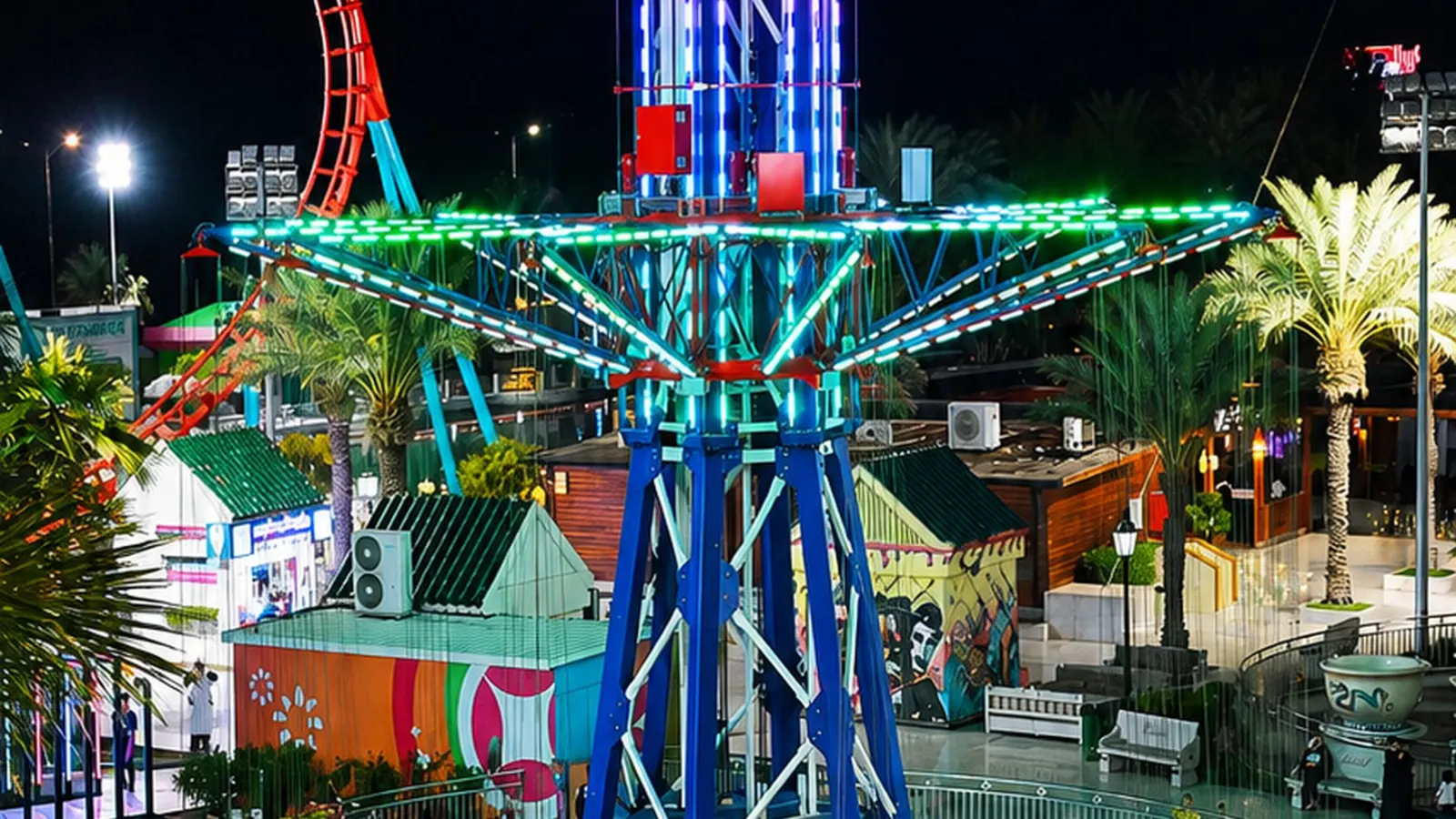
Most parks in the Gulf run American and European machines side by side. Each ride arrived with a design file written to a different rulebook, and the inspection that follows has to read both.
Two families, one purpose
ASTM F2291 is the American standard practice for the design of amusement rides and devices, maintained by ASTM Committee F24. EN 13814 is the European family for fairground and amusement park machinery and structures. Both exist so that a ride is designed against foreseeable loads, forces and rider behaviour before it carries a single guest. Where they differ is in structure, vocabulary and, in places, numbers.
The American approach spreads the life cycle across several documents: F2291 for design, F1193 for manufacture and quality, F770 for ownership, operation, maintenance and inspection, and F2137 for measuring a ride's dynamic behaviour. EN 13814 groups design, operation and inspection in one family of three parts. Either way, an operator does not answer to the design document directly. The manufacturer does. You answer to the operation side: F770, or the operation part of EN 13814.
What F2291 actually asks of a designer
A documented ride analysis
Before any calculation, the designer has to document a ride analysis: its scope and use cases, the hazards, the hazardous scenarios including maintenance tasks, and how each hazard is brought to an acceptable level. It contains a rider suitability assessment, a restraint and containment analysis, a clearance envelope analysis and a failure analysis such as an FMEA or a fault tree. For an inspection body, it is the single most useful document in an American design file.
Restraints derived from acceleration
The restraint is not a matter of preference. The standard maps the sustained accelerations a rider experiences onto a diagram with five areas, from no restraint required up to the highest class. That highest class calls for two independent restraints or one fail-safe device, automatic locking, unlocking by the operator only, and monitoring that stops the ride or prevents the next cycle if a locking device fails.
A clearance envelope you can measure
The space a rider can reach, plus a margin of three inches (about 75 mm), defines an envelope that must stay clear of structures and other objects. The designer also has to define how that envelope is measured on the assembled ride at its final location. That measurement is exactly what an inspector verifies on site.
Acceleration limits, verified by test
The acceleration limits are set for riders 48 inches (about 122 cm) and taller. A ride for smaller children that goes beyond them needs a justification reviewed by a biodynamic expert. On a new ride, design accelerations have to be confirmed by testing at commissioning, with the data filtered and evaluated by a defined method rather than read off a raw trace.
Structure and fatigue
Structures are analysed for strength and for fatigue against the number of load cycles they will see in service, with an impact factor of at least 1.2 on moving loads. The design basis is expressed in operational hours, with 35,000 hours as a minimum design criterion, not a retirement date. Drawings and calculations have to be kept for at least twenty years.
An operator never answers to F2291 directly. But almost every finding on an American ride traces back to an assumption written under it.
Why the Gulf makes the design file matter more
Several F2291 criteria read differently in a Gulf climate. Any part of a hydraulic system running fluid above 110°F (43°C) has to be shielded from riders, and where ambient temperature could damage components the design must keep the fluid within a safe range. On an exposed site in August, the ambient alone approaches that figure. Rides exposed to wind have to be designed, as a minimum, to operate in winds up to 15 m/s, and the operating instructions must state the limits. A shamal does not wait for the manual.
Neither family was written around surface temperatures on exposed steel, sand in bearings or UV on restraint polymers. That is why the design assumptions, and not only the certificate, need to be read against the site where the ride actually runs.
Mixed parks, one inspection logic
The working rule is simple: a ride is examined against the standard it was designed and declared to, not against whichever standard the inspector prefers. An American coaster with an F2291 design file and a European flat ride built to EN 13814 can stand fifty metres apart and be examined to different criteria on the same day. What has to stay constant is the method: design file, ride analysis, as-built condition, operating records.
- F2291 applies to rides manufactured after the edition in force was published, and to major modifications
- A design can qualify as service proven after five years in public service without significant unresolved design-related safety issues
- Go-karts and other rider-directed rides, climbing walls, air-supported structures, dry slides, coin-operated rides and water rides fall outside F2291 and are covered by other standards
Editions matter too. ASTM revises F2291 regularly, so the first question in any design review is which edition the manufacturer used, and whether the file says so.
Certis in the field
100+Locations
120+Standards we examine to
1000+Inspections performed
Standards referencedالمعايير المذكورة
ASTM F2291ASTM F770ASTM F1193ASTM F2137EN 13814
Key takeawaysالخلاصة
- F2291 governs design; operators answer to F770 or the operation part of EN 13814
- The restraint class is derived from measured acceleration, not chosen
- The ride analysis is the most useful document in an American design file
- Each ride is examined to the standard it was designed to, with one consistent method
This article is general technical guidance for the entertainment and leisure industry. It is not a substitute for an assessment of your own assets. For a position on your specific operation, talk to our engineering team.هذا المقال إرشاد تقني عام لقطاع الترفيه، وليس بديلًا عن تقييم أصولكم. للحصول على موقف يخص عملياتكم تحديدًا، تواصلوا مع فريقنا الهندسي.